
Poppy:AI Roleplay Chat
Fainax AppsEntertainment
4.6618.00 Reviews
- Version
- 1.0.7
- Installs
- 500.00K
- Age Rating
- Mature 17+
Screenshots


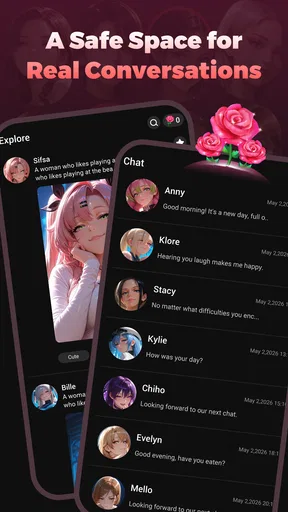

Our Review of Poppy:AI Roleplay Chat
 Analysis by Appyee
I spent time with Poppy:AI Roleplay Chat as an entertainment app, and my first impression was that it is built around conversation rather than quick, disposable content. Its central idea is simple: you chat with AI companions and let the relationship develop through continued interaction. That makes it more personal than scrolling through short videos, but also more dependent on the quality of the conversations you create.
Created by Fainax Apps, Poppy is available for free and has a mature 17+ content rating. It runs on Android 7.0 or later, so the minimum operating-system requirement is relatively accessible for people using older compatible phones. The current version is 1.0.7, and the app has already passed 500K installs with an average rating of 4.6 from around 14K ratings. Those figures suggest that the concept has found a sizeable audience, although popularity alone does not guarantee that every conversation will feel equally convincing.
How the free experience fits into everyday entertainment
The most important thing to understand about the cost is that Poppy is free to download and use as a starting point. I would not approach it expecting a clearly defined paid product with a guaranteed amount of content. The practical value comes from being able to open the app, choose the kind of interaction that interests you, and see whether the conversational style suits you before committing time or attention.
That free entry point makes it easier to test without treating the app like a major purchase. If you are curious about AI roleplay but do not want to pay before knowing whether you enjoy it, this is a sensible place to begin. At the same time, “free” should not be confused with unlimited value in every situation. Your enjoyment depends on how engaging the exchanges remain, how much patience you have for steering the conversation, and whether the available companions match the mood you want.
I also think the age label matters when deciding whether the app belongs on a shared family device. The 17+ rating is a clear signal that Poppy is aimed at mature users, not children or younger teenagers. I would keep that in mind before recommending it casually, especially if another person regularly uses the same phone or tablet.
The app is best viewed as a private entertainment space rather than a replacement for messaging with real people. It can respond when you are available, which is convenient, but it does not provide the mutual history, responsibility, or emotional understanding of a human relationship. That distinction is important because the roleplay framing can make an exchange feel more intimate than a standard chatbot session.
What I found useful during ordinary downtime
My favorite use case is a short evening session when I want something more active than watching another video but do not have the energy for a game. A conversation can begin casually and become a small creative exercise: I can establish a setting, decide how direct or playful I want the tone to be, and see how the companion reacts. That gives the app more participation than passive entertainment.
It also works well as a writing warm-up. Instead of opening a blank document and trying to invent a scene alone, I can use a roleplay exchange to test dialogue, character reactions, or a conflict. The useful trick is to treat the companion as a prompt partner rather than an authority. I decide what is believable, what fits the scene, and when the conversation needs to move in a new direction.
Another practical workflow is to start each session with a clear intention. For example, I might want a light conversation, a dramatic scene, or an improvised story. Without that small decision, the chat can drift and become repetitive. A focused opening gives the interaction somewhere to go and makes the free experience feel more worthwhile.
For people who enjoy experimenting with fictional personalities, Poppy offers a more immediate experience than writing every line themselves. I can respond naturally instead of planning a complete script. That is a real strength, but it comes with a trade-off: the app’s entertainment value is partly determined by how well I guide it. Users who expect the companion to carry every scene without input may find the experience less satisfying.
Where it differs from familiar entertainment apps
Compared with video platforms, Poppy asks me to participate. A video gives me a finished performance, while a roleplay chat changes according to what I write. That makes it more flexible, but not always as polished or predictable. When I want to relax without making decisions, a streaming app is usually the better choice.
Compared with ordinary messaging apps, the appeal is availability and imagination rather than a real social connection. There is no need to wait for a friend to answer, and I can explore a fictional scenario without worrying about whether another person is interested in the same premise. The downside is that the interaction lacks the genuine surprise and personal history that make human conversation rewarding.
Compared with a conventional story game, the experience is less structured. A game normally gives me objectives, rules, progression, or a designed ending. Poppy is looser. That freedom can be ideal for improvised scenes, but users who want a clear campaign or measurable progress may prefer an interactive fiction title or a narrative game instead.
This difference also explains why the app may appeal to one person and disappoint another. It is not trying to replace every form of entertainment. Its strongest space is between a chatbot, a creative writing prompt, and a private roleplay session.
Small habits that improve the conversations
The first habit I recommend is giving context in manageable pieces. A long opening message can be tempting, but a short description of the setting, the desired tone, and my character’s immediate goal is easier to build on. I can then add details naturally as the exchange develops. This keeps the conversation from feeling like I am reading a block of instructions instead of participating in a scene.
The second is correcting direction early. If the companion misunderstands the mood or takes the story somewhere uninteresting, I get better results by stating the adjustment plainly rather than continuing several turns and hoping it fixes itself. A sentence such as “keep this playful and focus on the mystery” gives the chat a clearer path than a vague reply.
The third is using scene changes deliberately. If a conversation starts circling the same topic, I can introduce a new location, a time jump, or a concrete problem. This is more effective than repeatedly asking the companion to be more interesting. Roleplay works best when I supply movement and consequences.
A less obvious benefit is that these habits make the app useful for practicing concise communication. I have to express tone, boundaries, and goals clearly enough for the exchange to follow them. That does not turn Poppy into a formal writing tool, but it can make casual use more creative and less passive.
The trade-offs behind the personal feel
The promise that companions can learn and grow with continued interaction is attractive, but I would interpret it carefully. A continuing chat can feel more coherent when I maintain a consistent premise and refer back to earlier events. That does not mean the companion understands me in the human sense, and I would avoid treating its responses as proof of memory, judgment, or emotional awareness.
This is where the mature rating deserves more than a passing mention. A roleplay app can invite users to share personal thoughts because the conversation feels private and responsive. I would keep sensitive information out of the chat and avoid using it as a place for secrets, financial details, identifying information, or serious personal decisions. The entertaining illusion of companionship should not lower normal digital caution.
There is also an emotional trade-off. Some users may enjoy having a companion available whenever they want to talk. Others may find that constant availability encourages them to spend more time in an artificial relationship than they intended. I would set a simple limit, such as using it for a defined session or a particular creative goal, rather than opening it automatically whenever I feel bored or lonely.
Conversation quality can also vary from one exchange to another. Even when the premise is strong, I may need to redirect the companion, repair a misunderstanding, or accept that a scene has lost momentum. That is normal for this kind of entertainment, but it means Poppy is not a perfect hands-off experience. Its best moments come when I actively shape the interaction.
The free price makes those limitations easier to tolerate because I can judge the experience without paying upfront. Still, free access does not remove the opportunity cost of attention. If the chat becomes repetitive, I am not receiving good value simply because no money changed hands. The right question is whether it gives me enjoyable or useful time compared with the other things I could be doing.
Who is most likely to enjoy Poppy?
I would recommend Poppy to adults who like improvisation, fictional dialogue, character experiments, and conversational entertainment. It is especially suitable for someone who wants a low-pressure creative partner: a place to test a scene, explore a personality, or unwind with an exchange that is more interactive than watching a screen.
It may also suit people who prefer flexible entertainment over fixed objectives. If I want to decide what happens next instead of following a predetermined story, the open-ended format is appealing. The app can be used for a few minutes or a longer session, depending on how much energy I have and whether the conversation keeps its momentum.
I would be more cautious recommending it to someone looking for dependable emotional support. An AI companion can be responsive, but it is not a therapist, trusted friend, emergency service, or substitute for real-world help. Someone who mainly wants human connection will probably get more lasting value from a messaging group, a call, or an activity with friends.
It is also not the best match for users who dislike typing or steering. Poppy’s appeal depends on participation. If I give minimal replies and expect a fully developed story to appear without guidance, the experience may feel flat. A structured game, a podcast, or a streaming service would be a better fit for passive relaxation.
Parents should take the mature rating seriously rather than assuming that a friendly-looking chat interface is suitable for every age. I would not hand it to a child as a general-purpose conversational toy. Adults who are comfortable with roleplay and understand the limits of AI companions are the audience most likely to appreciate what it offers.
Should you install it?
My verdict is positive, with sensible boundaries. Poppy gives adults a free way to try AI roleplay chat without first buying into a larger entertainment package. Its strongest value is not a single spectacular feature; it is the freedom to turn a short conversation into a creative scene, a character exercise, or a personal bit of downtime.
I would install it if I wanted an interactive alternative to scrolling, enjoyed making up scenarios, or needed a prompt partner for dialogue and storytelling. I would skip it if I wanted a structured game, polished linear narratives, genuine friendship, or professional emotional guidance. Those are different needs, and no conversational companion should be judged as though it were designed for all of them.
The most useful way to approach the app is to give each session a purpose, keep personal information out of the conversation, and be willing to redirect the roleplay when it loses focus. With that mindset, the free access offers a fair opportunity to discover whether the format works for you. Poppy is worth trying for mature users who want participatory entertainment, but its value comes from how thoughtfully you use the conversation.
Fainax Apps has positioned the app in an interesting middle ground between creative tool and casual entertainment. The 4.6 average from around 14K ratings and more than 500K installs show that many users are responding well to the idea, while the 17+ label and open-ended design explain why it will not be right for everyone. I would keep it for imaginative, short-form sessions rather than depend on it as my main source of connection or relaxation.
Verdict
Strengths of Poppy:AI Roleplay Chat
- Wide range of AI characters and roleplay scenarios to explore.
- Easy-to-use chat interface with quick, natural-feeling responses.
- Useful for creative writing, improvisation, and casual entertainment.
- Conversations can be personalized to match different moods and styles.
- New character interactions can make the app feel fresh over time.
Limitations of Poppy:AI Roleplay Chat
- Response quality can vary noticeably between different characters.
- Some conversations may become repetitive during longer roleplay sessions.
- The app may require an internet connection for most chat features.
- AI replies can occasionally misunderstand context or user intentions.
- Privacy details should be reviewed carefully before sharing personal information.
Similar Picks in This Category
View All
Google Play Games
Google LLC3.9

Netflix
Netflix, Inc.4.8

YouTube Kids
Google LLC4.2

Disney+
Disney4.4

Prime Video
Amazon Mobile LLC4.7

Steam
Valve Corporation3.2
Frequently Asked Questions
What is Poppy: AI Roleplay Chat, and what can you do with it?
Poppy: AI Roleplay Chat is an interactive chatbot app focused on fictional conversations and roleplay. You can chat with AI characters, create imaginative scenarios, and guide conversations by choosing your own messages and actions. It is designed for entertainment and storytelling rather than factual assistance, so responses can vary in quality and may sometimes be repetitive, unexpected, or inconsistent with the character’s personality.
Does Poppy: AI Roleplay Chat require an account or internet connection?
The app generally requires an active internet connection because conversations are processed through online AI services. Depending on the current version and platform, you may also need to create an account or sign in before accessing chats, character creation, or personalization features. Offline use is usually limited or unavailable, and the exact login requirements may differ between Android and iOS releases.
Is Poppy: AI Roleplay Chat free to download and use?
Poppy: AI Roleplay Chat may be available as a free download, but some features can be restricted by advertisements, usage limits, premium characters, subscriptions, or in-app purchases. Before starting a long conversation, check the app-store listing and its purchase terms carefully. If the app offers a trial, review the renewal conditions so you are not charged unexpectedly.
Is Poppy: AI Roleplay Chat suitable for children and teenagers?
Parents should review the app’s age rating, content warnings, and privacy policy before allowing a child or teenager to use it. AI roleplay apps may produce mature, romantic, frightening, or otherwise unsuitable replies depending on the conversation. Content filters can reduce certain results but are not perfect. Young users should avoid sharing personal information and should use appropriate parental supervision.
How private are conversations in Poppy: AI Roleplay Chat?
You should treat conversations in Poppy: AI Roleplay Chat as potentially stored or processed by the service, even when they appear private inside the app. Avoid entering passwords, financial details, precise location data, private photographs, or identifying information. Read the official privacy policy to understand data collection, retention, personalization, and third-party processing, and use the app’s available controls to delete chats or manage permissions.
